16th December 2025
ASB and crime
0191 2219800
enquiries@northumbria-pcc.gov.uk
Northumbria Police and Crime Commissioner Kim McGuinness needs your help designing this year’s Christmas card.
The theme this year is about celebrating where we call home… Christmas in Northumberland, Tyne and Wear.
To enter you must:
The winner will be announced on my social media channels at the start of December so keep your eyes out.
Good luck!
Kim
PS. I’d love to visit the winner at School with their local neighbourhood police officer.
Police Commissioner Kim McGuinness has promised to improve transport and park safety with an £800,000 investment in CCTV, Metro safety volunteers, increased lighting and a new reporting app.
The police commissioner is investing in two new packages of Safer Streets funding after hearing from women, passengers and park visitors setting out the places in Northumberland, Tyne and Wear where they feel less safe.
The investment follows national concern around women’s safety in light of the tragic murder of Sarah Everard.
The first safety package will see the Commissioner work with Metro operator Nexus, bus operators and the regional transport board on a £400,000 package including:
The second safety package sees another £400,000 go towards:
Investment will go to parks across all six council areas in Northumberland, Tyne and Wear, including Ashington’s Hirst Park, Gateshead’s Saltwell Park and Mowbray Park in Sunderland.
Police Commissioner Kim McGuinness said: “I want Northumberland, Tyne and Wear to have a first-class public transport network in which women and all passengers feel safe to travel. This £800,000 is a vital first step towards that.
“When people are on a bus or a metro they should know that there is always help at hand. We want to give the reporting of ASB a complete overhaul and make it so much easier for local people to get the help they need when they need it. We also want to implement practical solutions like help points and improve lighting. We want to support all this with educational campaigns to raise awareness and promote the support services that people can turn to.”
Cllr Martin Gannon Gateshead Council leader and chair of the region’s joint transport committee, welcomed the announcement.
He said: “It is great to see this investment to make public transport safer in the region. We recently set out a roadmap in the 2021 North East Transport Plan to build on the infrastructure in place to achieve a safer and more attractive transport network, which reflects many of the findings from the recent survey.
“This is a big step towards making people feel safe on our streets so that there is higher take up of walking and cycling, which are the greenest and healthiest forms of travel, as well as public transport use in the region.”
The funding is part of the Home Office’s Safer Streets funding pot. The scheme divides £25m among bidders across the country, but the funding must be spent by spring 2022.
Kim added: “It’s great we have this investment, but one off funding pots are not going to make women safer. We have to bring about longer term change, and that means longer term funding from the Government.”
![]()
“Young people shouldn’t have to say they are at the brink just to get the help they need”, warns Police and Crime Commissioner, Kim McGuinness as she calls on Government to urgently invest in young people and their futures
CONCERNS for the mental health of children in the Northumberland, Tyne and Wear have been raised by PCC Kim McGuinness, as new research also shows children in deprived areas are struggling to cope.
A national survey of more than half a million children across England revealed this week found that one in five children are unhappy with their mental health.
The national report comes just days after the Police Commissioner’s local services report, which pulls together the views of almost 100 North East youth work organisations, revealed that 78% of organisations are dealing with more young people displaying mental health concerns now than in 2011, following a decade of cuts to youth services.
They also said that now, more than ever, they are having to provide support to young people with increasingly complex mental health issues.
Overall, the report, conducted as part of Kim McGuinness’s preventing crime strategy, reveals a bleak outlook in terms of support for the younger generation.
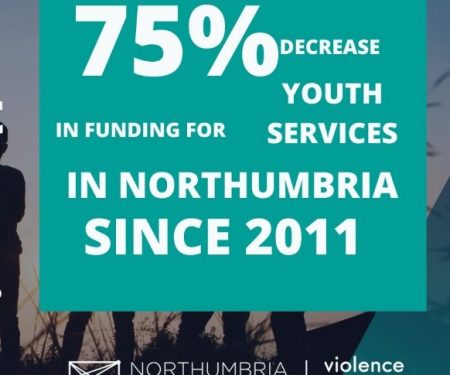
In fact, 71% of the youth organisations surveyed have seen their funding cut or reduced since 2011. Overall there has been a 75% decrease in local authority spending on youth services in Northumbria since 2011. This means funding has been slashed by £31.5 million pounds.
These findings have prompted the Commissioner to call on the Government for an urgent rescue strategy, to save the youth sector and young people from losing their way and provide early mental health support for those who need it.
Northumbria Police and Crime Commissioner, Kim McGuinness, said: “Poverty, deprivation, poor health, mental health and a lack of youth services– it’s all interlinked with crime and becoming vulnerable to it. Anyone who says these are excuses is wrong, these are often the root causes. You leave youth services to struggle; you leave young people to struggle. They go on to struggle as adults, as families, as entire communities. It’s that simple.
“South Tyneside and Sunderland, and Northumberland, Tyne and Wear are amongst the worst in the country for mental health treatment waiting times. This coupled with staff shortages means youth workers are telling us they are being forced to fill the gap in trained counsellors. It’s problem after problem. We hear that there is a mental health crisis happening and these findings show that is very much the case.
“Youth services and mental health support need to kick in early – before kids reach the youth offending service and before they get a drug and alcohol misuse service referral. We need to prevent things getting so bad that a social worker has to step in and intervene with their lives.
“The system is so very flawed if people need to be saying they are at the brink for the help to kick in. And we mustn’t forget the vulnerabilities – people with mental health problems are more likely to be victims of violent crime, rather than perpetrators. We find they are often preyed upon and get drawn into County Lines.”
“It’s the support and opportunities outside the home are critically important. Youth services can be a safety net catching children before they fall into crime or become a victim to crime. Our region, sadly, has some of the highest levels of deprivation in the country, and this impacts upon our wellbeing and mental health.”
The Police Commissioner added: “All too often the police and their 24/7 availability are left to pick up the pieces at the end of that 999 call, coming to the aid in moments of real crisis but it’s like things are being allowed to get that bad. We have youth services bridging the gap too, some really amazing ones but it’s not – nor should it be – up to them or the police alone.
“My Violence Reduction Unit is tasked with improving lives to prevent crime and I will make sure we are doing everything we can when it comes to supporting the next generation. You take away youth services you take away the opportunity to intervene. Problems we have will persist, or worse still, grow and we can’t let that happen in Northumberland and Tyne and Wear.”
To read the findings in full and the recommendations set out by the PCC please visit:
Voices from the Frontine – A report into the future of youth services
ENDS
Notes to editors
Key findings from Voices from the Frontline:
It features a series of key recommendations on how Government, local authorities and PCCs can come together to support future generations. These include:
People working with young people have shared their thoughts on topics such as funding cuts, staffing levels and concerns for future generations. Findings include:
Other information of note:
estimates that around 9.2% of 5-16 year olds in England have a mental health disorder, with the prevalence in the North East predicted to be slightly higher at 10.0%.
Northumbria’s Police Commissioner Kim McGuinness reacts to today’s hard-hitting report which calls for urgent, radical action to protect women and girls from violence. Kim said:
“This report couldn’t be any clearer and spells out what so many who work with victims and survivors have been crying out for, for years- action and change. The figures in the report are alarming and represent an epidemic of violent and abusive offending against women and girls across England and Wales.
“I don’t want to take anything away from the progress, hard work and commitment we have seen in recent years, including the progress in Northumbria Police, but the whole system has to work every, single, time.
“This report doesn’t tell us anything new though. In fact, we don’t need more reports about this we need change and change will only happen if it is backed up by the right level of funding. This is not something to be skimped and saved on and after 11 years in power it’s time for this government to step up.
“Time is ticking, there are women and children who are suffering unimaginable abuse. This cannot go ignored. Ignoring a problem only means it gets worse. We have to work to prevent it. This is absolutely a top priority for me, for our police and for our region and it’s about time it is for Government too. Through my Violence Reduction Unit, here in Northumbria we are really focusing on this prevention, working to stop reoffending and supporting families at risk of violence and abuse. Our police need all the support possible to help them to get a grip of this because it really is not a job for the police alone. Let’s hope this is the beginning of real change to protect and make women’s and girl’s lives safer.”
PRESS RELEASE
“LACK of youth services have hit our kids in the countryside the hardest”, says Police Commissioner Kim McGuinness as she publishes a new report on how a decade of cuts to youth services are exposing rural youths to criminality.
Fearing the worst is yet to come, PCC McGuinness is calling on the Government to urgently invest in youth services, particularly in rural communities, if serious about levelling up.
The research, conducted as part of the Commissioner’s preventing crime strategy, highlights how local youth provisions are at breaking point revealing the true toll budget cuts and the Coronavirus pandemic have had on youth services.
Echoing calls made by the National Youth Agency, she wants to see the Government working with local authorities, frontline services and young people to create a Rural Action Plan to radically transform the provision of youth services in rural areas, which in some parts is largely non-existent.
Youth services across England and Wales are struggling but the Northumbria police force area, comprising 6 local authorities, has been hit disproportionately hard, in particular the rural areas in Northumbria and elsewhere. There has been a 75% decrease in local authority spending on youth services in Northumbria since 2011, with Northumberland suffering the greatest financial blows.
In fact, the average net expenditure on youth services is currently £62 per head in urban areas, whereas in rural areas it is £47 per head (a decrease from £108/head in 2011).
Nothumbria Police and Crime Commissioner, Kim McGuinness, said: “Young people are telling us they have little, if any, access to youth provision; they say there is nowhere to go and nothing to do. They tell us all the action and opportunity is in the towns and cities and quite frankly they are getting a raw deal simply because of where they live. Some don’t have a clue what a youth club is. There are however some fantastic youth organisations supporting young people but the struggle to keep afloat is so real – we’ll see fewer and fewer at this rate. Some are already feeling there only choice will be to close.”
“Unfortunately the lack of youth services has most impact on teenagers who could get into trouble, even if they’re not already. They prevent problems arising and can prevent the vulnerable from getting caught up in county lines and other forms of criminality.
“Young people and their needs and constantly being overlooked. It’s particularly our rural youths who seem to be missing from the government’s levelling up agenda. Government is also missing a sense of urgency on this.”
She continued: “Without real investment 2.25m young people will be left behind living in predominantly rural areas, living in villages, towns and coastal areas, more than 30,000 of these young people are from Northumberland alone.”
The report, which pulls together the views of almost 100 North East youth work organisations, has prompted the Commissioner to call on the government for an urgent rescue strategy, to save the youth sector and young people from losing their way.
It features a series of key recommendations on how Government, local authorities and PCCs can come together to support future generations. As well as a Rural Action Plan (RAP), it recommends:
People working with young people have shared their thoughts on topics such as funding cuts, staffing levels and concerns for future generations.
Findings include:
A separate report by the Audit Commission into the benefits of sport and leisure activities in preventing anti-social behaviour by young people estimates that a young person in the criminal justice system costs the taxpayer over £200,000 by the age of 16. But one who is given support to stay out costs less than £50,000.
To read the findings in full and the recommendations set out by the PCC please visit
https://northumbria-pcc.gov.uk/youth-survey-kim-mcguinness/
ENDS
Round 1 of the Local Youth Fund closed on Friday 10th September 2021. To view a list of successful applicants please click here.
For more information, please contact the Violence Reduction Unit VRU@northumbria-pcc.gov.uk.