A senior British Transport Police officer has praised Northumbria’s Project Shield for helping drive down crime and improve passenger safety across the rail network.

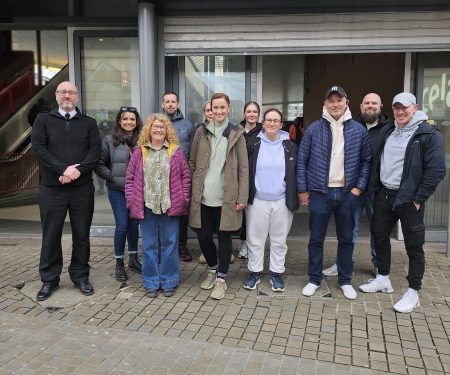
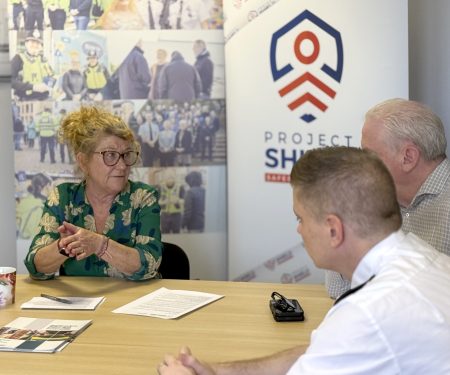
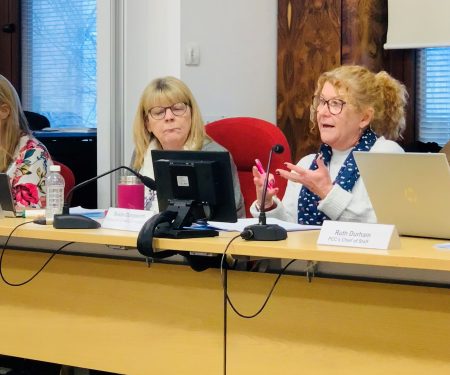
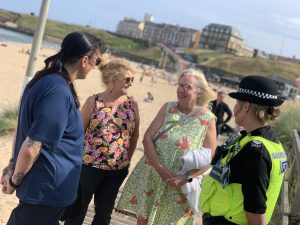
Superintendent David Rams, who met with Police and Crime Commissioner Susan Dungworth in North Tyneside last week hailed Project Shield a ‘first of its kind’ collaborative approach that he believes is really benefiting train passengers in the Northumbria Police force area.

Susan, who launched the project with partners last summer pledged her continued support to working with public transport providers to tackle anti-social behaviour (ASB) and crime – as outlined in her Police and Crime Plan for safer streets and stronger communities.

British Transport Police has long maintained a close relationship with Northumbria Police working together and drawing in support, planning for major events and responding to incidents. Project Shield has helped enhance this further and since its launch last year has funded an additional 7000 patrol hours and various joint operations.

Heightened visibility and collaborative work through the project has helped achieve impressive results with data from the latest quarter showing a 28% reduction in ASB across the transport hotspot, compared to the same quarter the previous year. There has also been a promising reduction in serious violence this year too, with incident numbers down 22% compared to the same period in the previous year.

As part of their partnership discussions, they also spoke about other shared concerns including county lines and the rise in the number of reports of violence against women and girls on public transport up and down the country.

Northumbria Police and Crime Commissioner Susan Dungworth: “British Transport Police may have a very specific and unique beat focusing on the safety and security of passengers – but these are people moving in and around our region – residents, commuters and visitors.  And so, we have a lot of shared priorities and focus areas, and I really believe the more joined up we are, the more benefits we will reap – boosting feelings of safety for our passengers and improving community confidence overall.

“Recognising the need to ensure transport safety is a priority here in Northumbria – that’s why we committed to making it a targeted hotspot for Project Shield and this is continuing as we plan the next phase of work. The project has helped deliver some real reductions in both ASB and serious violence, that both David and I very much welcome, I am keen to explore more ways we can work together to address issues and deliver safer stations and trains as well as streets.”

BTP Superintendent David Rams said: “The public’s safety is our number one priority, and we work tirelessly to protect everyone’s journeys on the railway network. We are aware that every offence is one too many and we work relentlessly alongside our policing partners and the rail industry to create a hostile environment for crime on the network,

“We have officers across the rail network around the clock, at stations and on trains, to detect and deter crime and to reassure the public.

“Everyone has the right to travel safely and peacefully and we encourage anyone who experiences anything that disrupts this to report it to us by texting 61016 or by calling 0800 40 50 40. In an emergency, always dial 999.”

Assistant Chief Constable Andy Hill, of Northumbria Police, said: “Everyone should feel safe and secure while using public transport in our region and we are proud of the part we are playing in reducing ASB incidents on the network.

“Project Shield continues to be an important operation in tackling crime across our communities and alongside partners we are committed to doing everything we can to keep the North East the welcoming place it is for all to live, work and visit.

“Through increased patrols and engagement activity right across the Force area, we aim to build on these encouraging results in the coming weeks and months.

“Please remember, if you need us we are here for you.”

ENDS


Our Stats

Northumbria Police and Crime Commissioner, Susan Dungworth, has welcomed the £800,000 funding boost for the National Rural Crime Unit (NRCU) and the National Wildlife Crime Unit – units that work with Northumbria Police to tackle a range of crime in the more remote areas of the Northumbria region.

The Home Office funds will enhance cross-force collaboration, bolster the use of technology and data, and improve the ability to target organised crime groups involved in these illegal activities.

Tackling rural crime is a priority in the PCC’s Police and Crime Plan which outlines her commitments to supporting Northumbria Police with the development of innovative crime prevention tactics and cross border intelligence sharing.

Recently Northumbria’s Rural Crime Team has been working closely with the NRCU investigating the theft of a large number of GPS units in the Morpeth area. The NRCU tracked a suspect down and Northumbria Police’s Rural Crime Team was able to make an arrest. The male arrested was linked to an international organised crime gang that was subsequently charged with a number of offences with a large number if GPS units recovered.

Earlier this month the Police and Crime Commissioner also joined officers as part of Operation Checkpoint to see first-hand some of the force’s activity to tackle rural crime. Operation Checkpoint is the largest rural operation of its kind in the UK, and it sees Northumbria Police, partners and volunteers join together with six other Forces, to stop crime, wildlife and poaching offences.

PCC Susan Dungworth, said: “As I’ve seen tonight, our police force services some of the largest rural areas in the country and so I welcome the recent investment to specifically tackle crime in such areas and protect our farmers and rural communities.

“Officers have been telling me how the NRCU’s knowledge, enthusiasm and support is invaluable and plays a key role in supporting our efforts to keep our rural communities safe and combat criminality in these areas.

“By giving extra funding to this unit shows that we have a government that is determined to ensure its Safer Streets Mission applies to all communities, no matter where they live – this can only be a good thing for Northumbria and its people.”

Minister for Crime and Policing Dame Diana Johnson said: “When you report a crime, it should be properly investigated, with victims having faith that justice will be delivered and criminals punished.

“But too often victims of crime in rural communities have been left feeling undervalued and isolated, whether it be famers having equipment or livestock stolen, or villages targeted by car thieves and county lines gangs.

“This new funding, alongside the forthcoming Rural and Wildlife Crime Strategy and our Neighbourhood Policing Guarantee, will help deliver the change rural communities deserve, ensuring no matter where you live your streets are safe and police responsive to your local needs as we continue to deliver on our Plan for Change.”

The National Rural Crime Unit is headed up by Northumbria police superintendent Andy Huddleston, he said: “I am grateful to the Policing Minister for both her support of the NRCU and the critical funding she has provided. This will ensure the crucial role of the National Rural Crime Co-ordinator, that has been pivotal in information sharing and joint operations across the UK continues.

“Secondly the minister’s contribution to the replacement of the Operational Team vehicles is equally important as it will allow the continued support of forces on the ground and recovery of equipment which since the inception of the team in 2023 stands at more than £23 million.”

Supt Huddleston added: “Rural crime has a truly devastating impact on victims and their livelihoods, and there is no place for this form of criminality whatsoever in our communities.

“Operation Checkpoint always delivers results – and that is down to the fantastic teamwork between all of the Forces, officers, and volunteers who dedicate their time and efforts into making it a success.

“Checkpoint is one of a number of our rural operations alongside partners and volunteers which form part of our robust response to rural crime

“However, our hard work does not stop here and we all look forward to maintaining our efforts to ensure all of our rural communities remain safe places to live, work and visit.”

ENDS

Our Stats

AMBITIOUS plans for the next phase of Project Shield- a targeted policing and community engagement initiative – have been presented at a partnership event, as Government funding continues for another year.

The project aims to tackle anti-social behaviour (ASB) and serious violence through a partnership approach and increased visibility through uniformed patrols. It supports Police and Crime Commissioner Susan Dungworth’s mission to deliver safer streets and stronger communities for local people.

Funding of £1.8m was secured for the project by the Office of the Police and Crime Commissioner (OPCC), following a successful bid to the Government’s Hotspot Action Fund.

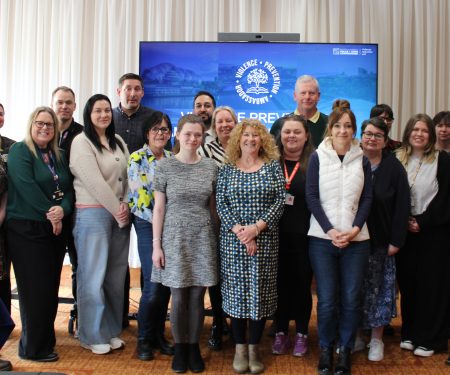
The planning event was attended by the OPCC, Northumbria Police, British Transport Police, Nexus, Stagecoach and all six local authorities across the Northumbria Police force area.

In addition to the ‘boots on the ground’ the Shield teams also consists of analysts and researchers to help guide deployment and identify trends and emerging issues.

Activity is rolled out in targeted areas identified through data and local intelligence. Through a mix of engagement and law enforcement, the project aims to help grow confidence in policing and encourage reporting. In addition to uniformed patrols, the teams deliver days of action and various problem-solving activities in key areas.

Since launching last year, Project Shield has helped deliver a 12.5% reduction in serious violence in targeted areas, when compared to the previous year. It’s also helped deliver a nearly 20% reduction in ASB in these areas too. In total the partnership has delivered 31,244 patrol hours, 227 arrests, 288 stop and searches, 3667 stop checks, used ASB powers 339 times and made 77,029 engagements.

Northumbria Police and Crime Commissioner, said, Susan Dungworth: “Since launching Project Shield last year, we have seen it go from strength to strength – as the results demonstrate. It was great to get partners together today to showcase the impact everyone’s hard work is having.”

“The positive impact of the project is being felt far and wide. I’ve had residents in our key areas telling me they’re seeing more uniforms and feeling safer. I’ve also had retailers in our town centres contacting me praising the impact the additional patrols have had. There’s been a lot of interest from the Home Office too.”

She added: “Project Shield supports many of the priorities I set in my Police and Crime Plan for safer streets and stronger communities. My commitments include ensuring we have an engaged and responsive police force, tackling serious violence and reducing crime and antisocial behaviour – Project Shield helps towards it all.

“Today’s partnership event was also about looking ahead and exploring how we build on our success – so we keep cutting crime and keep improving how safe people feel in their communities. People want more of this work and that’s what we are coming together to achieve.”

Assistant Chief Constable Andy Hill, of Northumbria Police, said: “Collaborative working is key to the continued success of Project Shield and we are pleased to have been able to meet up with partners to outline our latest plans to further tackle anti-social behaviour and serious violence in our communities.

“I want those in our Force area to be reassured that we remain committed to identifying those responsible for such criminal activity while also addressing the root causes of these issues.

“We’ve had great feedback from members of the public, who tell us that Project Shield is having a tangible and positive impact on their lives and thanks to renewed funding for 2025/26, we aim drive down the number of incidents in the coming months.”

 ENDS

Our Stats

NORTHUMBRIA Police are set to become the first, and only, Force in the country to offer new recruits a direct route into community policing.

Normally, new starters have to complete a two-year training programme which covers a wide variety of policing.

In this trailblazing move, those who chose the neighbourhood option will specialise in this area from joining and will develop the specialist skills needed for the community policing role. This pathway can be accessed by graduates, non-graduates and those seeking a degree level apprenticeship

The scheme is in response to the Government’s Neighbourhood Policing Guarantee (NPG), which aims to place more officers in local areas with a focus on visible patrols, community engagement, and tackling issues like anti-social behaviour and crime.

Northumbria Police has been given funding to recruit an additional 95 neighbourhood officers, 27 PCSOs and 30 Special Constables over the next 12 months.

Northumbria Police’s Assistant Chief Officer, Joscelin Lawson, said: “This is a really exciting time to be part of something special here at Northumbria Police.

“We have always valued neighbourhood policing – which provides the visible presence on our streets that we know our communities want – and this will enable us to strengthen that even further.

“This new offer opens up a completely new route, with different skills sets.

“Policing is so much more than 999 calls and responding to emergencies. Neighbourhood policing is about visible, trusted officers and staff who understand their area and tackle the issues that matter most to people.

“So, if you are passionate about where you live and want a career with a purpose and makes a real impact, then we would love to hear from you.”

Northumbria Police and Crime Commissioner, Susan Dungworth, said: “This is a great move by Northumbria Police to get police officers exactly where residents want to see them – out there in their communities, and it gets my full support.

“As PCC, my mission is clear – I want safer streets and stronger communities, and this new initiative delivers on that. It also shows we have a police force that is putting the Government’s Neighbourhood Policing Guarantee into action with fresh thinking.

“As well as being a benefit to neighbourhoods, it’s also a great way for us to attract good people with the right skills, strengths, and ambitions from a range of backgrounds. It will help get them straight into doing the work they want to do – building effective working relationships with people from
all walks of life that will help prevent crime and support local people. I look forward to meeting successful applicants and seeing them policing the streets following this summer’s recruitment drive.”

Applications for the new Neighbourhood roles will open in June, but you can register your interest now at: Expression of Interest – Direct Entry into Neighbourhood Policing

Also follow the Force’s social media channels for more information.

Meanwhile Northumbria Police are currently recruiting for other police officer, staff and volunteer roles.

Visit the careers website at Careers – Northumbria Police


Our Stats

Northumbria Police have been praised for their approach in preventing crime – and significant improvements have also been recognised in answering 999 calls.

An inspection by His Majesty’s Inspectorate of Constabulary and Fire & Rescue Services (HMICFRS) further highlights how the Force works with partners to combat anti-social behaviour.

The PEEL (police effectiveness, efficiency and legitimacy) report published today (Wednesday) also recognises the success of Operation Capio – a dedicated initiative to tackle motorcycle-related crime.

The report hails a scheme aimed at preventing children becoming involved in knife crime – known as a Trainee Detective Programme – as innovative practice.

The ground-breaking project focuses on the tragic death of 18-year-old Connor Brown, who was killed in Sunderland, and educates young people about the dangers of knife crime. During the course virtual reality technology is used to transport the participants to the crime scene.

The report recognises continued improvements in answering 999 calls. Since the inspection even greater improvements have been made and the Force is now exceeding the HMICFRS target for answering emergency calls.

The inspection, which concluded in December, has also highlighted the positive impact of new ways of working which have been implemented over the past 12 months.

Most notably, this includes increasing the number of area commands – from three to six. This recognises that communities have their own identities and issues which matter most to them. Moving to this structure allows the Force to best respond to these needs.

The new model will also help ensure it can better meet both current and future demands.

Amongst positive findings, the report does raise areas for improvement and the Force have already made progress in addressing these and this work will continue.

This includes replacing ageing IT infrastructure – with significant investment being made on a new Force-wide system which will help improve the service provided to the public and drive efficiencies.

The report also recognises inconsistencies in some areas – but the Force has reiterated its commitment to providing the highest levels of service to all, especially  victims.

Chief Constable Vanessa Jardine said: “I am delighted the inspectors have highlighted innovative practice, including around how we prevent and deter crime.

“If we can help prevent someone from becoming a victim – or stop someone becoming involved in crime that is a positive outcome for all.

“Significant improvements have also been recognised in our 999 call answering – and this is vital so we can continue to be there for those who need us most.

“I am pleased the report further recognises the efforts we are making, alongside our partners, to tackle anti-social behaviour including our response to motorcycle-related crime.

“Our new ways of working, including moving to six area commands also means we are better meeting the needs of our communities – and tackling the issues which matter most to you.

“I would like to take this opportunity to thank our officers, staff and volunteers for their efforts and commitment, and to our communities for their continued support.

“We are absolutely determined to deliver an outstanding service to all.”

Northumbria Police and Crime Commissioner, Susan Dungworth, said: “As Police and Crime Commissioner, I want us to be doing all we can to deliver safer streets and stronger communities for everyone and there are many strengths highlighted in this report that show Northumbria Police is already doing great work to help achieve this.

“The Trainee Detectives Programme, which I help fund through the Violence Reduction Unit, is a great example of how we are working together to educate and prevent crime to help create resilient communities for the future.

“I have made being an engaged and responsive police force a priority in my Police and Crime Plan to keep this as a real focus going forward.

“My office will continue to play a key role in monitoring delivery and performance through my new scrutiny programme to ensure the policing response is both efficient and effective and I am confident under the Chief Constable’s leadership further improvements will follow.”


Our Stats


Northumbria’s Police and Crime Commissioner, Susan Dungworth, has said additional funding has been secured to help protect children growing up with domestic abuse around them at home.

Today, Government announced £5.3 million for services supporting children affected by domestic abuse, within the Preventing Violence Against Women and Girls and Supporting Children (PVSC): Children Affected by Domestic Abuse (CADA) grant.

This means the Northumbria Police force area has an additional £178,976.94 of funding to deliver support locally to children and young people affected by domestic abuse. This brings the total level of CADA funding from 2022-2026 to £570,210.94, a 25% increase compared to the previous year’s funding.

Local services commissioned by the Office of the Police and Crime Commissioner include Acorns, Action for Children, the Angelou Centre, Community Counselling Cooperative, Impact Family Services and Wearside Women in Need.

These organisations will continue to offer a range of support from 1:1 counselling and group work, to play therapy and therapeutic support for children alongside their non-offending parent.

Last year, these organisations all exceeded their service targets and extended their service offer due to rising demands.

Altogether, 382 children were supported with 1:1 and group work sessions, 280 joint parent and child sessions were delivered, and 244 parents were involved in engagement work.

Northumbria Police and Crime Commissioner, Susan Dungworth, said: “It is so important that children grow up in a safe and stable environment. Sadly, not all do – so it’s vital they have somewhere to turn, especially those growing up in an environment where they’re exposed to stress, controlling behaviours and even violence. These children experience the domestic abuse and are very much the victims too.

“We know the damaging impact domestic abuse can have on the development of children and young people, so we need to do all we can to make sure they have access to the right support to help them cope with and overcome their experiences.

“Recent years have been a real struggle for services – they’ve been crying out for more funding to offer specialist support to children and feel it’s been more of an afterthought or an add on, yet it needs to be a priority area in its own right.

“They’ve been telling me demand keeps rising, but the money hasn’t been – so this latest funding boost really is a long due increase.

“I am thankful that we have a government who recognises this need and is taking steps to put this right. Of course, we need to keep pushing for more money, but it’s certainly a start and it all helps towards national targets set to halve VAWG over the next decade.

“I’m also particularly thankful to all our CADA services who, despite the financial challenges, have shown such commitment to supporting, advocating for and empowering the children they work with – they’ve been making a difference to so many lives.”

Tackling violence against women and girls (VAWG) is a priority in the PCC’s plan for safer streets and stronger communities. In both her Plan and VAWG Strategy she has outlined a commitment to ensuring all victims of domestic abuse have access to the best support services to meet their needs – and that includes children.

Maxine Tennet, from the Acorns Project, a specialist domestic abuse support service based in North Tyneside and Northumberland, said: “We are delighted at the increase in available funding. Especially as it acknowledges the urgent need to support child victims-survivors of domestic abuse.

“Children have been the hidden victims for so long, and this funding is a crucial next step in ensuring Acorns can continue providing specialist care and support to help them heal and thrive.”

More than 800,000 children in England and Wales are believed to be living in a home where a parent is enduring domestic abuse, according to a recent study.

Under the Domestic Abuse Act, children are classed as victims if they see, hear, or experience the effects of abuse and they are related to the victim or offender. More information on victim services commissioned by the Office of the Police and Crime Commissioner can be found here.

ENDS

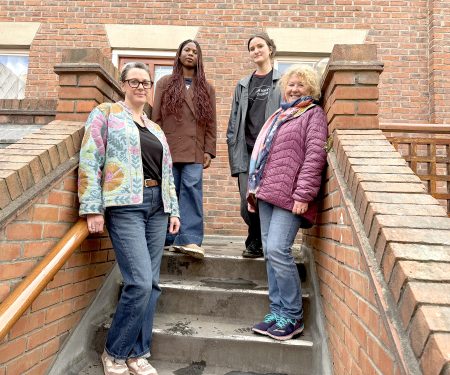
PHOTO: Susan Dungworth at the Angelou Centre – one of the commissioned service providers

Our Stats

Exit
Site