COMMUNITY hubs, youth organisations and neighbourhood support services are struggling more from the cost-of-living crisis than during the Covid-19 pandemic, new research from the North East has found.

Kim McGuinness, Northumbria’s Police and Crime Commissioner, whose office conducted the research, has warned frontline organisations supporting those in need are struggling with needs of their own – and are desperate for Government to take notice.

The Commissioner has called on Government to introduce emergency Cost of Living grants for charities and neighbourhood groups – as happened during the pandemic.

A survey of nearly 100 frontline organisations aimed to find out how community groups are supporting people through the cost-of-living crisis and to better understand the ongoing concerns of those they support.

Issues raised have ranged from struggles with paying bills, difficulties affording transport to accessing support, and worries around rising crime.

Findings include:
  • Nearly three-quarters (71%) of organisations who responded are now supporting more service users now than 12 months ago.
  • Over half of the organisations felt that the cost-of-living crisis has had a bigger impact on their organisation compared to the Covid-19 pandemic.
  • The impact of increased costs has also had a negative knock-on impact to crime experienced locally – 55% of organisation reporting increased incidents local to them.

The majority of organisations reported that this crisis has impacted their service even more than the Covid-19 pandemic with many attributing this to the lack of financial support from Government.

The Police and Crime Commissioner’s office helps fund over 140 organisations across Tyne and Wear to prevent crime and improve lives. Representatives from nearly 100 services and community groups voiced their views as part of the survey.

Northumbria Police and Crime Commissioner, Kim McGuinness, said: “These community groups and support services have been, and continue to be, a lifeline in the cost-of-living crisis. With some of the highest poverty rates in the country, there’s no doubt the people of the North East are suffering the most.

“We know bills are going up but it’s more than that – one youth worker said kids are coming to them asking ‘what’s for tea?’. That’s because kids are hungry, they don’t want to stress their mams and dads but they need to eat.”

She continued: “All these groups and hubs are ran by people who are motivated with the desire to help others and improve lives in their local neighbourhoods but they are only coping themselves by taking drastic measures. We’ve been hearing how they have been forced to cut salaries, use up reserves, and cancel sessions – it’s clearly a very stressful time for so many.”

Miss McGuinness is calling on the Government to provide a support package for community groups to cover space, transport and funding. She said: “Many people are telling me they feel nobody is recognising all they are doing and nobody is offering to help foot the bill.

“We all know the pandemic took its toll but there was a lot of short-term funding opportunities which have now come to an abrupt end and a lot of vital work and services will come to an abrupt end too if Government doesn’t step in here.”

Research figures include:
  • 55%, over half of respondents, felt that there had been an increased number of increased requiring a police response locally. Only 6% of all respondents felt that this had decreased in the same time period.
  • 95% of organisations who responded stated they’ve noticed their service users struggling as a result of the cost-of-living crisis.
  • 79% of respondents admitted that they are struggling to meet the demand that their organisation currently faces from service users.

The full report and research can be viewed and downloaded here.

ENDS

Our Stats

POLICE leaders have warned that a police staffing crisis looms despite Government recruitment efforts – as there is still no long-term funding plan to get officer numbers back to pre-austerity levels.

This week the Home Secretary is expected to announce that 20,000 officers have joined UK policing as a result of the high-profile national uplift programme. 

But Northumbria’s Police Commissioner Kim McGuinness says this is no time for celebration as the targets were never enough in the first place and hopes any announcement will include plans for the continued growth needed to fight crime.

Since 2010, Northumbria Police has taken the biggest financial hit of all the forces in England and Wales – losing more than 1,100 officers and £148m in budget cuts – a result of what the PCC calls ‘grossly unfair and regionally biased’ budget cuts.

The Government-funded recruitment campaign was set up to replace officer numbers nationally, but Northumbria Police was only allocated the funds for a maximum of 615 additional recruits. This is 520 short meaning that locally uplift targets set by Government have barely replaced half of those lost.

Northumbria Police and Crime Commissioner, Kim McGuinness, said: “Even if the uplift pledge has been met – this is hardly a time for celebration. The numbers suggest police forces are 30,000 officers short of what is needed to keep the British public safe.

“We all know police numbers are nowhere near what they once were. Our communities know – they can tell. In Northumbria, we have exceeded uplift targets and that’s been our own making, our own financial planning, our own difficult decisions – we’ve had to go above and beyond as Government targets were nowhere near enough.

“Our population is growing; poverty is growing yet police numbers are plummeting. Nationally, it’s claimed forces need 50,000 to join to make any meaningful difference so we just have to sit tight until we know more. If there’s no continuation, no real plan, people will be put at risk and communities will suffer. Our region will suffer. 

“We’ve been plagued by cuts in the North East and need a commitment to a consistent recruitment cycle. We need Government to give us back our cops.”

The Police Federation that represents rank-and-file officers has said forces need 50,000 to join to make any meaningful difference.

Steve Hartshorn, chairman of the Police Federation of England and Wales, said: “No doubt it sounds impressive but when juxtaposed against the massive funding cut levied since 2010, which resulted in over 20,000 fewer officers, the annual loss of around 7,000 officers and population growth of more than 3.5 million over the last decade, does it really offer hope of being able to provide a better service?” 


Our Stats

PRESS RELEASE

POLICE Commissioner Kim McGuinness is calling on those who work with men and boys across the region to take up new training to help challenge the behaviours that support harassment and violence against women and girls.

‘Active bystander training’ is a new programme launched this week by the Commissioner’s office as part of determined efforts to prevent the unwelcome behaviours that can increase the likelihood of abuse occurring.

Bystander intervention is viewed by experts as a way that can be effective in preventing assault from happening. This new training is a powerful tool taking you through the steps from noticing a problem, having the confidence to act and determining the best course of action to take.

The innovative training has been designed to empower bystanders and is being delivered by national behaviour change specialists, Kindling Transformative Interventions and Beyond Equality. The training seeks to equip people with the skills and confidence needed to speak up when they notice behaviours that aren’t right such as harassment, sexual harassment, or problematic and threatening behaviour.

National figures show 71 per cent of women have experienced harassment in public spaces. A recent survey by the Commissioner’s office revealed the majority of women would like to see more initiatives to drive the change in attitudes and behaviours towards women and girls. The PCC is making this happen and wants to ensure men and boys are included in part of the solution to tackle the misogyny and sexism that are often at the root of the problem.

Organisations that have signed up to become Active Bystander Trainers so far intend to empower more than 3000 men and boys and people in our communities to become active bystanders before the end of 2023.

Northumbria Police and Crime Commissioner, Kim McGuinness, said: “If no one confronts these sexist behaviour and attitudes people continue accepting them as normal – this has to change. By doing nothing we empower the harasser so it’s on us all – we all have to do something.

“It really isn’t always just banter“ she continued, “it’s about how it makes us feel, and what these attitudes and behaviours can lead to.”

“I want people to know there is always something you can do as a bystander and the more active bystanders we have in the North East, the bigger change we can make and the more we can positively impact wider culture on this.

“I really want to urge people, businesses, organisations to get signed up and be that difference. Be the guy telling your mate to pack it in or check a woman is OK. The majority of people know what’s right and what’s wrong and when they see things they want to call it out and intervene but many people are just not sure how to go about it.

“I hope this training will bring real, lasting change to workplaces, organisations and communities across the North East. I see it as an important step forward empowering others in the fight against violence against women and girls and improving lives.”

Lee Crosby, Head of Youth and Community Education at the Foundation of Light in Sunderland, one of the local organisations already signed up said: “The Foundation of Light are proud to part of this new initiative launched by the Police and Crime Commissioner and will use the Active Bystander training to challenge negative behaviours, including harassment and violence against women and girls in the various projects we deliver.

“We want to support the Police and Crime Commissioner’s work embedding positive messages and behaviours throughout the work we do, whilst ensuring prejudice behaviours and attitudes are challenged so women and girls feel safe in the communities in which we live and work.”

Nate Eisenstadt, Co-founder of Kindling and Senior Research Associate at University of Bristol said:

“We’re at a place now in society where most people know when they see something harmful unfolding – what many of us lack is the confidence and skillset to intervene in ways that are effective. This training is about doing just that – it offers people a practical set of tools to step up respond to harm and prevent escalation.

The training is free to attend and is funded as part of the OPCC’s Safer Streets project and the Northumbria Violence Reduction Unit.

More info and to sign up click here 

ENDS

Our Stats

Northumbria Police and Crime Commissioner Kim McGuinness reacts to Government ASB plans saying “this changes nothing, we still need more police on North East streets and more investment in crime prevention”

GOVERNMENT plans to deal with anti-social behaviour have been met with criticism by a Police and Crime Commissioner who says the announcement simply does not go far enough to reverse 13 years of police and council cuts.

Ministers are to hand Northumbria Police limited funds for extra patrols and making offenders repair the damage they have caused but will not be providing the long-term investment in youth services and family support needed to reverse ASB.

The Government’s latest pledges follows deep cuts to frontline policing since 2010 and Kim says the promises distract from urgent calls to put more officers on the beat.

Since 2010, Northumbria Police has taken the biggest financial hit of all the forces in England and Wales – losing more than 1,100 officers and £148m in budget cuts. Northumbria Police now has 12 per cent fewer officers than it did back in 2010.

Police and Crime Commissioner Kim McGuinness said: “13 years of government cuts have caused a rise in ASB and now we’re only getting half the solution. Government has announced limited funds for extra police patrols, but they still owe Northumbria more than 500 extra officers to reverse cuts to police numbers.

“Ministers say they want to tackle ASB but if they do not invest long term in preventing ASB with good neighbourhood services, in youth workers and councils and community hubs, the Government will simply run out of money to deal with those people committing ASB.”

She continued: “This isn’t to make an excuse for those who blight our neighbourhoods, cause damage or make victims of their neighbours.  But in the long-term we can’t arrest our way out of crime.  If we don’t devolve the ability to invest in public services and create real opportunity, we’ll constantly be sending police officers, or the council or the housing association back to the same neighbourhoods to deal with the same repeat offenders from the same households.

“Any funding we can get our hands on for the North East we will welcome but it’s too little too late. Government needs to be to bring child poverty down, to eliminate the root causes of anti-social behaviour and until it does we will be in the position where we simply need more cops on the streets.”

ENDS


Our Stats

PRESS RELEASE

“Give us back our cops”, demands PCC Kim McGuinness in the face of soaring 999 calls

999 calls to Northumbria’s police control rooms are rising at very high levels prompting urgent pleas from Police Commissioner Kim McGuinness for Government to “Give us back our cops”.

December 2022 saw 13% more grade 1 calls made across Northumberland, Tyne and Wear, compared to 2021, and 52% more compared to the pre-pandemic December in 2019. Figures also show that 999 calls last year rose by 9% in contrast to the previous year.

Kim McGuinness has said she’s determined to ensure officers can respond to vital calls and that the public receive the service they deserve, but has criticised Government recruitment targets saying they don’t even come close to what they were pre-austerity, and that our police and North East communities are being let down.

Since 2010, Northumbria Police has taken the biggest financial hit of all the forces in England and Wales – losing more than 1,100 officers and £148m in budget cuts – a result of what the PCC calls ‘grossly unfair and regionally biased’ budget cuts.

The Government-funded recruitment campaign was set up to replace officer numbers nationally, but Northumbria Police was only allocated the funds for a maximum of 615 additional recruits. This is 485 short meaning that locally uplift targets set by Government have barely replaced half of those lost.

This has led the Police Commissioner and Northumbria Police decided to set their own targets and get more neighbourhood officers out serving local communities. This has resulted in Northumbria Police’s officer headcount growing from 3,129 to 3,744 but the Police Commissioner says that’s still not enough.

Criticising Government for failing to put police officers back on our North East streets Kim McGuinness said: “Police demand is at an all-time high and yet Government funding continues to fail the people of the North East.

“As soon as a 999 call comes in we need to be getting officers out there responding to the needs of the public. And we need a well-resourced force to deliver this. It really is vital that our officer recruitment matches this growing demand. Quite frankly the targets set by Government show how out of touch they are with our needs.  What they have set out to achieve is not uplift, it’s not how we fight crime and it’s not how we look after the North East”.

“This is why the Chief and I prioritised recruitment and set out our own recruitment drives designed to smash Government targets. It’s far from easy balancing the books though but we fully recognise there’s nothing more important than keeping the people of our region safe. It’s about time Government did too and it’s about time they gave us back our cops.”

ENDS

Notes to editors:

Grade 1 incident demand remains high. For the period January to December 2022, there has been 13% more grade 1 incidents compared to the same period in 2021 and 37% more compared to the same period in 2020. It is acknowledged that during the COVID-19 pandemic incident demand volumes changed; however, when comparing to the same period in 2019 there is a 52% increase.

And

For the 12 months to December 2022, the number of 999 calls increased by 9% compared to the previous 12 months, from 269,769 to 300,941.

Our Stats

PRESS RELEASE

COMMUNITY centres, sports clubs, youth groups and park projects are among the latest grass root causes set to benefit from a fund that uses cash stripped from criminals across the North East returning it to the heart of the community.

£225K worth of money that crime fighting police officers have seized from drug dealers, human traffickers and thieves is being channelled into a range of community projects thanks to the latest round of Police Commissioner Kim McGuinness’ Operation Payback fund.

Before Christmas, the Commissioner revealed where some of the latest money obtained through the Proceeds of Crime Act had come from. It included cash and assets with a total value of £57,685 that were seized by officers in Sunderland when a man was arrested for drug possession with intent to supply, as well as kidnap. The offender is now serving time in a prison in Belgium.

This money is now being used to fund work Such as Pallion Action Group’s ‘Care To Achieve Project’ that offers support and opportunity to young people caught up in ASB and the criminal justice system.

Operation Payback is part of Kim McGuinness’ plan to get money back into the right hands – the hands of those who are improving lives and preventing crime in their local neighbourhoods.

The latest round of funding sought to help bring game changing ideas to life and give local kids opportunities that would keep them out of trouble both during school holidays and throughout the year.

Northumbria Police and Crime Commissioner, Kim McGuinness, said: “We’ve seen lots of successful police activity of late involving raids and arrests where lots of money has been taken out of the wrong hands. Today I am announcing where that money is going to go and how we can use it to improve lives by fighting poverty and fighting crime.

“There’s no better use for cash seized from crime than channelling it right back into our communities – particularly areas that need it most or where we are wanting to clampdown on things like anti-social behaviour. It’s about presenting kids with the chance to do things they want to do, keeping them entertained or even making sure they are fed and feel supported in life.

“From Friday night youth clubs and dance classes to knife crime awareness sessions – I am really pleased with the range of activities that are going to be on offer through this round of funding. And thanks go to the hardworking officers who are disrupting organised crime and seizing the money connected to it so we can invest it back into the organisations who are making a difference right in the heart of the local community.”

Detective Chief Inspector Chris Riley, of Northumbria Police, said: “Taking the money out of the hands of criminals and investing it back into the communities these crimes have impacted – that’s a wonderful feeling.

“This round of funding will be used to fund schemes such as ‘Fit to Fed’, a project that sees free boxing lessons followed by a free meal provided to children in Gateshead. It’s amazing to see something so positive and inspiring come out of this.
“Work will continue on all sides to disrupt and dismantle organised crime and those profiting of their criminal actions, with the money seized being invested back into the amazing communities we serve.”

Operation Payback is part of a much wider of action happening across the Northumbria Police force area as part of plans to tackle issues like ASB and knife crime.

The aim of the fund is to support the work of Northumbria Police and help prevent crime and anti-social behaviour, which will in turn improve lives for local people.

Funded examples by area:

SUNDERLAND:

Pallion Action Group            Funding will be used for the delivery of the ‘Care To Achieve Project’ to raise the aspirations/skills/knowledge/experience for young people caught up in ASB and/or the criminal justice system.

GATESHEAD:

Leam Lane Amateur Boxing Club   Funding will be to run further “Fit to Fed” sessions during the school summer holidays, with the aim to provide free sessions to the youths of the area followed by a hot meal.

NORTHUMBERLAND:

Hexham Youth Initiative       Funding will be used towards the work of qualified and experienced detached youth workers on the Sele in Hexham.  This is a large area of open space in the centre of town which includes play areas, recreation spaces, a bandstand, bowling green and a skate park.

NEWCASTLE:

Fenham Association of Residents  This grant will be used to create a project around safety for young people. They will focus on knife crime by creating a project aimed at talking to young people about community safety and creating a short film, to raise awareness.

NORTH TYNESIDE:

Power Through Sport CIC   Funding will go towards targeting diversionary activities at the Friday Night Youth Club, which was initially funded by North Tyneside’s Community Safety Team as part of their Project VITA campaign.

SOUTH TYNESIDE:

Sea Change South Shields CIC      Funding is to host educational workshops to reduce ASB as part of weekly neurodiverse social club, this will prevent antisocial behaviour and also educate members if they ever find themselves in a difficult situation.

A full list of beneficiaries can be found here Operation Payback Round 4 – Full list of confirmed groups

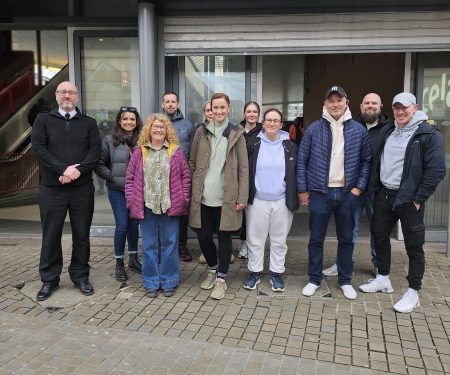
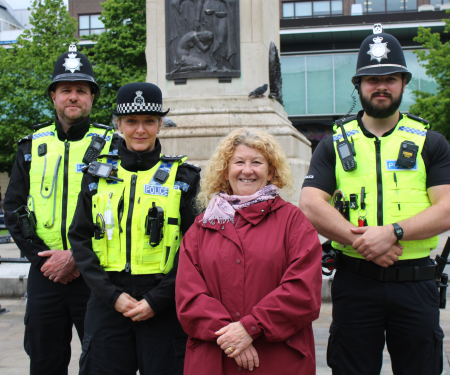
PHOTO: Kim McGuinness and officers from Northumbria Police and Bensham Court Tenants and Residents Association. Funding is to be used towards the costs of running the food bank which assists up to 70 people daily.

Our Stats

Exit
Site