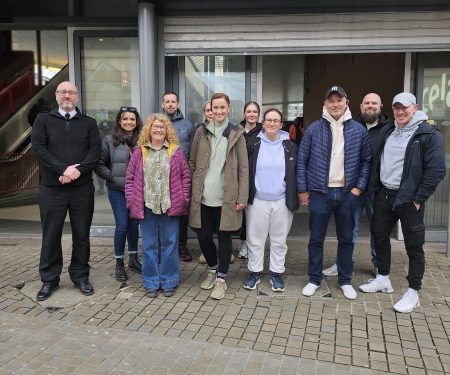
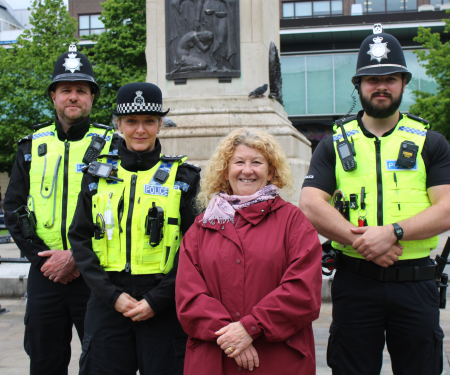
SUSAN Dungworth, the newly-elected Police and Crime Commissioner for Northumbria, has said her priority is clear – safer streets and stronger communities.

At a meeting with the Chief Constable on her first official day in the job, Susan said she wanted to build a bigger policing presence and vowed to champion local communities to ensure neighbourhood policing best meets their needs.

As a former youth justice worker and councillor, with decades of experience representing people and developing policy, she said she knows the issues people face and will do all she can to fight for people’s right to feel safe.

Police and crime commissioners are elected to represent the public on policing matters and hold their local force to account.

Susan Dungworth was elected at the count which took place in Sunderland on Thursday 2nd May, 2024. She is replacing Kim McGuinness who has held the post for five years, after being elected in the Northumbria force by-election in July 2019.

Susan’s first day in the office was Thursday 9th May and she began her day meeting Chief Constable, Vanessa Jardine, and setting out her vision for a bigger policing presence and outlined the following priorities:

  1. Reduce serious and violent crime
  2. Tackle anti-social behaviour
  3. Strengthen neighbourhood policing
  4. Communicate with and listen to you
  5. Fight for properly funded police and public services

New Northumbria Police and Crime Commissioner, Susan Dungworth, said: “I have spent my life fighting for our communities and by taking on this role my fight is really stepping up a gear. I have been out there, speaking to people on their doorsteps for decades and I know the issues they have and the concerns they have. And so, my offer to people is clear – I’ll do everything I can to make our streets safer and our communities stronger.

“I moved up here in the eighties and have never left. I chose to raise my family here because of the community spirit and the people, and I want to make sure everyone else who chooses to work, live or visit here feels safe, protected and supported. Good neighbourhood policing is key to this.

“Over the next few weeks, I’ll be listening, and I’ll be learning – what needs are being met and what aren’t. Consulting with the public and those we work with; I will then develop a plan that builds on existing success and sets out new ways to tackle the challenges and push Northumbria Police to be the best it can be.

“I already have a lot of respect for our police force, I know how hard officers, staff and volunteers all work despite what feels like never ending budget pressures at the hands of Government. Over the years, locally a lot has been done to fight and prevent crime as well as supporting victims, but there is so much more left to do and we need to keep bettering ourselves. Community policing must reflect current needs. I am grateful to those who voted and put their trust and confidence in me to take what is a big task on. I now want to get going so together with the Chief Constable we can deliver safer streets and stronger communities for everyone in our area.”

Chief Constable Vanessa Jardine said: “I look forward to working with Susan to help ensure we can continue to keep our communities safe and be there when people need us.

“As a Force, we are absolutely determined to provide an outstanding service and I know this is a vision the Police and Crime Commissioner fully supports.”


Our Stats

SUSAN DUNGWORTH has been elected as Police and Crime Commissioner for Northumbria in the 2024 local election on Thursday 2nd May.

There were four candidates vying for the role and Susan, the former leader of Northumberland Labour, was announced as the winner at the count which took place in Sunderland.

She will replace Kim McGuinness who has held the post for five years, after being elected in the Northumbria force by-election in July 2019.

The local authorities taking part in the Northumbria election area are: Gateshead, Newcastle, North Tyneside. Northumberland, South Tyneside, and Sunderland.

PCCs aim to cut crime and deliver an effective and efficient police service within their police force area. They are elected by the public to hold Chief Constables and the force to account, making the police answerable to the communities they serve.

Susan’s manifesto commits to ‘Safer Streets and Stronger Communities’. The priorities she cites include reducing serious and violent crime, tackling ASB and a focus on neighbourhood policing.

Information about all the votes cast including local breakdown of results can be found here HERE.


Our Stats

The Office of the Police and Crime Commissioner is now in the pre-election period ahead of the PCC elections on 2nd May.

The pre-election period describes the period immediately before elections or referendums when specific restrictions on communications activity are in place for public bodies and their staff in order not to unfairly influence the outcome of an election.

To ensure fairness amongst candidates, the Office of the Police and Crime Commissioner (OPCC) is restricted in making public announcements in the run up to the vote.

Any news items or photographs published on this website and our social media channels before 21st March relate to the serving PCC, Kim McGuinness.

References to the serving PCC have been retained on the OPCC website where they are valid and current. This does not imply that the Office supports any particular candidate in the election on 2nd May.

The OPCC does not support any political party and cannot endorse any of the candidates in the election.

We will treat all PCC candidates objectively and equally and will make due preparations to ensure that the OPCC is able to provide support to the elected candidate in time for the term of office which commences seven days after the election.

To vote in the PCC elections, you must be over 18 and registered to vote.

Find out more information about the PCC Elections 2024.


Our Stats

Charity Crimestoppers has launched a new campaign appealing for information about the dangerous use of off-road motorbikes across Northumberland and Tyne & Wear.

Riding off-road motorbikes in public open spaces is illegal. They often cause significant damage by scarring green spaces, damaging property and other vehicles in the process. Riders also put themselves and other people’s lives in danger.

This new campaign, funded by the Northumbria Police & Crime Commissioner, Kim McGuinness, encourages local communities to give information to Crimestoppers 100% anonymously, with the aim of helping to make our local streets safer.

To pass on information about the illegal use of off-road motorbikes completely anonymously, visit the Crimestoppers website (Crimestoppers-uk.org). You can fill in a safe and secure form or you can call the 24/7 UK-based Contact Centre on 0800 555 111. Young people can also report crime via the charity’s youth service website Fearless.org.

Help to keep our communities safe and tell us what you know about off-road motorbikes being used illegally. Useful information includes:
• The exact location, date and time the bike/s were seen
• Anything distinctive: colour, make, number plate details
• Where they are stored
• Who is riding them illegally and what they were wearing
• The names of those responsible for causing criminal damage or putting the public and themselves in danger.

Fleur Brown, North East Regional Manager at the charity Crimestoppers, said: “There are rising concerns over the illegal use of off-road motorbikes. Complaints often centre around these bikes being a threat to the public as they are ridden recklessly in residential areas, town centres, on pavements, green spaces as well as along beaches – with riders having no concern for their own safety or that of the public.

“Please help to keep our communities safe. Tell our charity anonymously who is involved in riding off-road bikes illegally, putting their and others’ lives at risk and damaging property and the environment. You may think that what you know is insignificant, but it may be a crucial bit of information that’s needed. Please tell us what you know and you will remain 100% anonymous.

“We understand that for many, it takes a lot of courage to go online or pick up the phone to pass on what you know. However, by taking that step of contacting Crimestoppers, you are helping to make our communities a safer place.”
Northumbria Police and Crime Commissioner, Kim McGuinness, said: “This campaign is the latest effort in a raft of work we are delivering in the North East to crack down on motorbike related anti-social behaviour. From investing in drones in the skies to running highly successful policing operations, we are pulling out all the stops to tackle this issue head on.

“Now, with the help of Crimestoppers, we are turning efforts to asking the public for help – any information, big or small, could be crucial to catching offenders and freeing our communities of this behaviour that’s both a nuisance and incredibly dangerous. I know motorbike disorder is a real concern for some of our residents and this campaign is an opportunity for people, who perhaps don’t want to report to the police or want to remain anonymous, to come forward and do their bit to help fight and prevent this crime in their area.”

Please note: With Crimestoppers-uk.org and Fearless.org, computer IP addresses are never traced and no-one will ever know you contacted them. For telephone calls to Crimestoppers via 0800 555 111, there is no caller line display, no 1471 facility and calls have never been traced.

Our Stats

The need to tackle serious violence remains a key priority, with the new strategy setting out a long-term united approach to addressing the root causes of violence, and making communities safer.

With Newcastle already having seen a 1.5% reduction in serious violence over the last 12 months, and other areas starting to show signs of increases slowing down, the 5-year plan aims to continue building on the work in preventing violent crime.

Earlier this year, the introduction of the Serious Violence Duty placed an expectation for local authorities and services to work together to prevent and reduce serious violence.

This led to the development of the Northumbria Response Strategy following a series of consultations to understand local priorities around serious violence, and how it can be prevented.

Through this partnership approach, it has led to the development of five key priorities:

  1. Creating stronger systems by bringing together partners from a broad range of backgrounds, and taking a public health approach to tackling serious violence, with improved services and support for communities.
  2. The use of data and intelligence which is critical to understanding the nature of serious violence, enabling resources to be targeted in areas most in need of action.
  3. Prevention and early intervention activity provides a greater chance of improving the lives of the most vulnerable individuals and communities, as well as reaching them at the earliest point.
  4. Enforcement remains a crucial element in combatting serious violence by enabling the force to pursue, disrupt and prosecute violent offenders.
  5. Supporting communities in understanding the impact and consequences of serious violence, and enabling them to be part of the solution in making local areas safer for everyone.

The strategy, approved at a recent board chaired by Police and Crime Commissioner Kim McGuinness, focuses on educating young people at the earliest point, identifying individuals causing the most disruption to local areas, reducing the risks for communities, and ensuring intensive intervention is in place to challenge and change behaviour.

Produced by a range of partners, the local plan brings together the Northumbria Violence Reduction Unit, Northumbria Police, Local Authorities, Fire Services, Health and Probation, all with a shared commitment to addressing the causes and impact of serious violence.

Northumbria Police and Crime Commissioner, Kim McGuinness said: “We are starting to see signs of violence levels slowing but there is still so much more to be done. This isn’t just about quick fixes – it’s about fostering long-term solutions that address the root causes of violence. We all have a crucial role to play, which is why this strategy brings together a range of partners, all with an unwavering commitment to preventing violent crime.”

“Through the Violence Reduction Unit we will continue to reach the most vulnerable individuals at the earliest point, and ensuring they have the knowledge needed to make positive choices. With a range of targeted initiatives, we will work alongside partners to identify violent offenders, engaging them in interventions to address their behaviour and prevent reoffending. However, where offenders choose not to engage, I want them to know that enforcement action will be taken.”

She added: “With this partnership approach and the priorities we have set out, we will continue to do all we can to tackle serious violence, and make communities safer.”

For more information, and to view the full Northumbria Response Strategy, visit the Violence Reduction Unit website.

Our Stats

A local partnership has launched a new programme supporting people in Newcastle who are worried about their behaviour towards a partner or ex-partner. 

The Make a Change programme helps people concerned that they are hurting, scaring or controlling their partner to change their behaviour. Newcastle is the latest area to roll out the service, which is already available in Durham and Sunderland. Anyone can get in touch to ask for non-judgemental, free support, for themselves or someone else. 

In Newcastle, Make a Change is provided by local charities Harbour and Changing Lives. The programme was developed by domestic abuse charities Respect and Women’s Aid Federation of England, and is funded by the Office of the Police and Crime Commissioner for Northumbria, in partnership with Newcastle City Council. 

Participants will be supported by Harbour’s expert support workers to understand the impact of their harmful behaviour, to make positive changes and develop healthy relationships.  

Lesley Hill, Make a Change Coordinator at Harbour, said: “This programme gives people who are worried about their behaviour a chance to get help to change as soon as possible. It’s somewhere they can learn about the effects harmful behaviour can have on the whole family and improve relationships with past, current or future partners. I’ve been part of delivering the programme in Durham and I’ve seen first-hand the difference it makes.” 

One man who completed the programme said: “Make a Change has made huge changes to me and my family’s life. It’s given me hope. I can go forward understanding my boundaries and actions and the effect that they have on the ones around me. The tools I have gained are invaluable.” 

Another central part of the programme is that partners and ex-partners of people taking part will be offered separate, confidential support by Changing Lives. This helps to identify the issues that are being experienced and improve safety and wellbeing. 

Laura McIntyre, Head of Operational Services at Changing Lives, said: “We’re excited to partner with Harbour to offer another route to support for people in Newcastle. The way that the programme helps people at an early stage will mean we can reach more people experiencing harm from a partner or ex-partner and help them make the choices that are right for them.” 

A woman whose partner completed the programme in another area said: “The most important thing was being heard. The support helped me realise how bad things had got. My support worker was absolutely wonderful and I can’t praise her enough.” 

As well as working directly with people who are worried about their behaviour, and their partners and ex-partners, Make a Change offers support to the wider community to help people who have concerns about someone else’s relationship. Local organisations and professionals can join free training to understand harmful behaviour in relationships, learn how to spot the signs and approach the issue safely and effectively. Harbour’s support services will also offer wider help and alternative programmes for people who require different or more complex support. 

Northumbria Police and Crime Commissioner, Kim McGuinness, said: “It’s fantastic we’re bringing the Make a Change programme to Newcastle and that we’re really growing its presence here in the North East so we can improve lives. Getting in there with the right response at the earliest opportunity before someone’s harmful behaviours continue and get worse is what this support is all about.  

“It provides people causing harm with the help they need to change by recognising and understanding the extent of the damage their behaviours have on their partner or ex-partner, and not forgetting the children too. It really is about prevention. With this work comes community and staff awareness raising too so everyone can play their part in spotting signs and shining a light on harmful behaviours as soon as possible and helping make a change.” 

Cllr Paula Maines, Cabinet Member for a Resilient City, Newcastle City Council said: “I am proud that we are partnering with the Make a Change programme. It is a very positive step for Newcastle and shows our commitment to reducing the impact of people using harmful behaviour, on both adults and children, by tackling it at the root cause. This initiative is key to identifying and engaging with those individuals causing harm and helping them to understand, identify and reflect on harmful norms, behaviours and dynamics in their own lives.” 

For more information, or if you are worried about you or your partner’s behaviour and want some support, call 03000 20 25 25, email info@myharbour.org.uk or visit the Make a Change website at www.makeachange.uk.net 

Our Stats

Exit
Site